




NANO特刊征稿|聚焦下一代电子和光电子学的先进纳米材料、器件和电路
特刊详情
客座编辑
- 王建禄,复旦大学
- 黄海,复旦大学
- 王旭东,中国科学院上海技术物理研究所
- 梁佳,复旦大学
- 张旭涛,西北工业大学
- 李文武,复旦大学
- 张鸿,复旦大学
主题范围
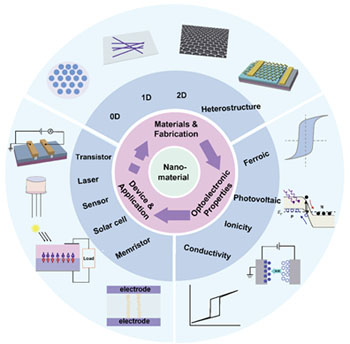
This focus collection aims to showcase cutting-edge advances in nanomaterials, device structures, and circuit design strategies that are driving the future of electronics and optoelectronics. Special emphasis will be placed on interdisciplinary approaches that integrate materials science, device engineering, and system-level innovations. Contributions are invited in areas ranging across computing, sensing, imaging, and beyond—where nanotechnology plays a fundamental role in redefining the capabilities of modern and future technologies.
Topics of interest include, but are not limited to:
- Nanostructured materials, including quantum dot (0D), nanowire (1D), two-dimensional (2D) materials
- Advanced nanomaterial fabrication and optoelectronic properties characterization
- Optoelectronic device using advanced nanomaterials, including photodetectors, photovoltaics, lasers, spintronics, etc.
- Nanoelectronic and optoelectronic circuits and integration
This focus collection serves as a unique platform for fostering interdisciplinary collaboration among materials scientists, electronic and optoelectronic device researchers, and experts from related fields, aiming to accelerate the integration of nanomaterials and nanotechnologies into next-generation electronic and optoelectronic applications.
客座编辑简介
Jianlu Wang obtained his Ph.D. from Shanghai Institute of Technical Physics, Chinese Academy of Sciences. From 2010 to 2021, he served as an Assistant Professor, Associate Professor, and Professor at the same institute. He joined Fudan University in 2021 as a full Professor. His primary research focuses on novel optoelectronic materials and detectors, ferroelectric material physics and devices, as well as optoelectronic sensing chips and systems. He has published over 100 SCI-indexed papers in prestigious journals, such as Nature Materials, Nature Electronics, Nature Communications, Advanced Materials, and Nano Letters, with more than 10000 citations, and holds an H-index of 57. He also serves as deputy editor for the Materials Today Electronics journal.
Hai Huang obtained his Ph.D. degree from the University of Chinese Academy of Sciences in 2018. From 2016 to 2020, he conducted doctoral and postdoctoral research at Stanford University / SLAC National Accelerator Laboratory (USA). Since 2021, he has been an Associate Professor at Institute of Optoelectronics, Department of Materials Science at Fudan University, China. His research interest focuses on the novel low dimensional optoelectronic materials and devices, particularly the development of advanced photodetectors operating across a broad spectral range—from deep ultraviolet to mid- and far-infrared. He has authored more than 40 papers in SCI-indexed journals, which have garnered over 2,400 citations.
Xudong Wang obtained his PhD from Xiangtan University in 2018. From 2018 to 2021, he completed postdoctoral research at the Shanghai Institute of Technical Physics, Chinese Academy of Sciences. From July 2021 to date, he has been working at the Shanghai Institute of Technical Physics, Chinese Academy of Sciences, where he is currently a young researcher and the academic leader of the State Key Laboratory of Infrared Physics. His main research direction focuses on advanced infrared materials and devices, and he has done a lot of research on the mechanism and devices of local field enhanced infrared detection. In recent years, he has mainly conducted research in narrow bandgap semiconductor materials and focal plane infrared detectors, and has presided over or participated in the completion of many major scientific and technological tasks. His research results have been published in more than 80 SCI papers, which have been cited more than 5,000 times. His H-index is 36.
Jia Liang received his Ph.D. in Physical Electronics from Peking University (China) in 2015. From 2015-2017, he then served as an Assistant Researcher at the School of Chemistry and Chemical Engineering, Nanjing University, followed by a postdoctoral fellowship at the Energy Materials and Surface Sciences Unit, Okinawa Institute of Science and Technology. From 2018 to 2020, he was a Nicholas Fellow at the Smalley-Curl Institute of Rice University. Since 2021, he has been an Associate Professor in the Department of Materials Science at Fudan University. His research interests include the fabrication of low-dimensional materials and their applications in valleytronics and energy devices. He has authored over 60 publications with more than 5000 citations and has a H-index of 33.
Xutao Zhang received his Ph.D. in Microelectronics and Solid-State Electronics from the Shanghai Institute of Technical Physics, Chinese Academy of Sciences, in 2019. From 2017 to 2018, he was a visiting Ph.D. student at the Research School of Physics, Australian National University. He is currently an Associate Professor at the Institute of Flexible Electronics, Northwestern Polytechnical University. His research focuses on III-V micro/nano optoelectronic devices. Over the past year, he has been particularly focused on the controlled epitaxy of nanowires and their laser properties. He has published more than 30 papers in SCI journals and has led several projects, including those funded by the National Natural Science Foundation of China.
Wenwu Li received his Ph.D. degree in Microelectronics and Solid State Electronics from East China Normal University in 2012. From 2012-2014, he worked as a postdoctoral researcher at National Institute for Materials Science and China Southern Power Grid Corporation. From 2014-2021, he worked as a full Professor at East China Normal University. Since August 2021, he is serving as a full Professor at Fudan University. His research field focuses on semiconductor electronic devices (transistors, memory, and synaptic devices), semiconductor material physics, and ferroelectric materials. He has published over 100 research articles, including Science, Science Advances, Nature communications, and IEEE EDL/TED.
Hong Zhang is a Research Professor and Deputy Director of State Key Laboratory of Photovoltaic Science and Technology at Fudan University. He received his Ph.D. in July 2018 from the University of Hong Kong under the supervision of Professor Wallace C.H. Choy on perovskite solar cells. From 2019 to 2021, he worked as a Post-doc with Prof. Michael Graetzel on highly efficient perovskite solar cells at École Polytechnique Fédérale de Lausanne. His current research interests mainly focus on the design and synthesis of perovskite and metal oxide inks as well as their application in perovskite optoelectronics, including solar cells, photodetector, and LEDs.
投稿流程
特刊文章与Nanotechnology期刊常规文章遵循相同的审稿流程和内容标准,并采用同样的投稿模式。
有关准备文章及投稿的详细信息,可以参阅IOPscience页面的作者指南。
作者可登入期刊主页进行在线投稿,在“文章类型”中选择“特刊文章”,并在“选择特刊”的下拉框中选择“Focus on Advanced Nanomaterials, Devices and Circuits for Next-Generation Electronics and Optoelectronics”。
我们鼓励尽早提交文章,因为文章将在接收后立刻发表,而不会因特刊中的其他文章延迟。
期刊介绍
- 2024年影响因子:2.8 Citescore:6.2
- Nanotechnology(NANO)创刊于1990年,是第一本纳米科研和技术领域的专业期刊。NANO发表纳米技术研究发展前沿的高水平研究论文及纳米研究进展的综述,主要集中在纳米能源、生物和医学、电子和光子、图案和纳米加工、传感和驱动、材料合成和材料性能等领域。