




ERL特刊精选|Focus on Methane Drawdown
特刊详情
客座编辑
- Robert Jackson,美国斯坦福大学
- Desiree Plata,美国麻省理工学院
- Gabrielle Dreyfus,美国治理与可持续发展研究所 (IGSD)
- Sam Abernethy,美国斯坦福大学
- Celina Scott-Buechler,美国斯坦福大学
主题范围
Since methane has high warming potential and a relatively short atmospheric lifetime, reducing its emissions (e.g. mitigation) is one of the fastest ways to slow warming. Methane removal (e.g. enhanced oxidation) may prove to be a crucial lever to address hard-to-abate emissions and begin drawing down the atmospheric methane that has already warmed the planet by 0.5 °C.
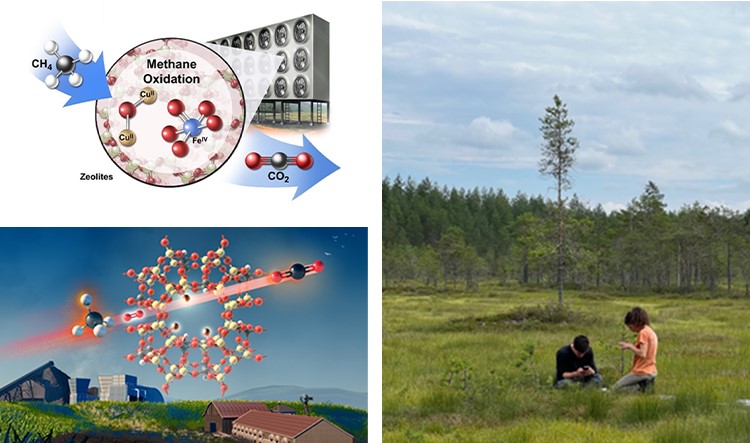
This focus issue emphasizes methane mitigation and removal through oxidation at relatively low methane concentrations of <2000 ppm, for which few or no commercial options are currently available at scale. Many methane mitigation and removal technologies oxidize methane to carbon dioxide, the eventual fate of all methane released into the air. However, this process occurs on a timescale of up to a decade or two, jeopardizing more immediate climate goals. How can we generate knowledge and technologies to extend methane oxidation to lower-concentration sources—working our way towards eventual atmospheric removal at ~2 ppm CH4?
Examples of the knowledge and technology gaps we hope to address in this focus issue include:
- Technologies and concepts – engineered, physical, chemical, or biological – for oxidizing low-concentration methane sources, including from the agricultural and waste sectors and natural emissions;
- Sensors and measurement approaches that could be applied to low-concentration sources to increase available data, improve understanding of sources and sinks, and monitor and verify future methane mitigation and removal activities;
- Opportunities to enhance methane sinks (i.e., oxidation) in air, water, soils, and engineered systems;
- Quantifications of co-benefits and unintended consequences (e.g., co-produced gasses) associated with methane mitigation and removal technologies;
- Assessments of governance and social acceptance for technologies that propose releasing radicals or other oxidizing agents into the open air, including the social justice and distributional implications of environmental protection
- Atmospheric modeling, including controls on oxidative capacity, mixed-phase processes and transport;
- Enhanced microbial oxidation of methane in nature, ruminants, and in controlled systems
特刊文章
Perspective
Atmospheric methane removal may reduce climate risks
Sam Abernethy and Robert B Jackson 2024 Environ. Res. Lett. 19 051001
Forests and methane: looking beyond carbon for nature-based climate solutions
Vincent Gauci 2024 Environ. Res. Lett. 19 081005
Temperature responses from methane mitigation approaches vary widely due to non-methane impacts
Sam Abernethy et al 2024 Environ. Res. Lett. 19 081006
Human activities now fuel two-thirds of global methane emissions
R B Jackson et al 2024 Environ. Res. Lett. 19 101002
Early engagement will be necessary for atmospheric methane removal field trials
Celina Scott-Buechler and Sikina Jinnah 2024 Environ. Res. Lett. 19 111010
Letter
Scott P Seymour et al 2023 Environ. Res. Lett. 18 084004
Andy Hardy et al 2023 Environ. Res. Lett. 18 074044
Examining the effect of cost information and framing on support for methane regulations in Europe
Parrish Bergquist and Paasha Mahdavi 2023 Environ. Res. Lett. 18 094046
Sam Abernethy et al 2023 Environ. Res. Lett. 18 094064
Global methane pledge versus carbon dioxide emission reduction
B B Cael and P A Goodwin 2023 Environ. Res. Lett. 18 104015
Daniel James Lundberg et al 2023 Environ. Res. Lett. 18 114039
A high efficiency gas phase photoreactor for eradication of methane from low-concentration sources
Morten Krogsbøll et al 2024 Environ. Res. Lett. 19 014017
Biochar-composting substantially reduces methane and air pollutant emissions from dairy manure
Brendan P Harrison et al 2024 Environ. Res. Lett. 19 014081
Exploring the bounds of methane catalysis in the context of atmospheric methane removal
Aliki Marina Tsopelakou et al 2024 Environ. Res. Lett. 19 054020
Evaluating the potential of iron-based interventions in methane reduction and climate mitigation
Daphne Meidan et al 2024 Environ. Res. Lett. 19 054023
Living emission abolish filters (LEAFs) for methane mitigation: design and operation
Richard Hamilton et al 2024 Environ. Res. Lett. 19 054057
Cost modeling of photocatalytic decomposition of atmospheric methane and nitrous oxide
Richard Randall et al 2024 Environ. Res. Lett. 19 064015
Economics of enhanced methane oxidation relative to carbon dioxide removal
Conor Hickey and Myles Allen 2024 Environ. Res. Lett. 19 064043
The impact of internal climate variability on OH trends between 2005 and 2014
Qindan Zhu et al 2024 Environ. Res. Lett. 19 064032
Evaluating the contribution of methanotrophy kinetics to uncertainty in the soil methane sink
Hannah Dion-Kirschner et al 2024 Environ. Res. Lett. 19 064059
The use of δ13C in CO to determine removal of CH4 by Cl radicals in the atmosphere
Thomas Röckmann et al 2024 Environ. Res. Lett. 19 064054
How much methane removal is required to avoid overshooting 1.5 ∘C?
Chris Smith and Camilla Mathison 2024 Environ. Res. Lett. 19 074044
Julie S Miller et al 2024 Environ. Res. Lett. 19 094011
Physical and practical constraints on atmospheric methane removal technologies
Luisa Pennacchio et al 2024 Environ. Res. Lett. 19 104058
Assessing the design of integrated methane sensing networks
Lekha Patel and Jake P Zenker 2024 Environ. Res. Lett. 19 124011
期刊介绍

- 2024年影响因子:5.6 Citescore: 11.1
- Environmental Research Letters(ERL)以金色开放获取模式出版,作者可选择将原始数据作为补充资料与文章一起发表。所有研究人员可以免费获取这些研究成果。ERL汇聚了关注环境变化及其应对的研究团体和政策制定团体的意见,涵盖了环境科学的所有方面,出版研究快报、综述文章、观点和社论。ERL顺应了环境科学的跨学科发表的趋势,反映了该领域相关的方法、工具和评估战略,得到了来自不同领域的广泛贡献。