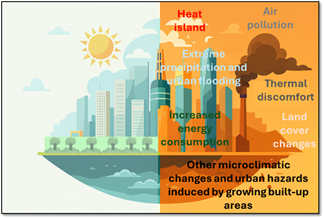
The entire world is currently undergoing a rapid process of urbanization. By 2050, it is estimated that approximately 68% of people will reside in urban areas (World Cities Report, 2022). This scale of urbanization brings significant changes to land use and land cover (LULC), which in turn alters various physical and biophysical factors that influence local climate. Key climatic modifications caused by urbanization include the urban heat islands, changes in wind and precipitation patterns, water pollution, and urban flooding. Urbanization also leads to increased air pollution levels through added emission sources such as construction, vehicular traffic, and increased population density. Such vulnerabilities and losses directly affect the lower income strata more and result in decreased working force population since repeated intense weather extremes could force them to shift out affecting the economic situation as whole.
In parallel, global climate change further amplifies these urban vulnerabilities. Rising temperatures intensify heat stress and energy demand, while sea-level rise threatens low-lying coastal cities through flooding, saline intrusion, and infrastructure degradation. The growing frequency of intense storms, heat waves, and extreme rainfall events place additional strain on urban drainage, transportation, and energy systems. These compound pressures highlight the urgent need to enhance urban climate resilience.
Urban climate resilience can be achieved through a combination of nature-based solutions, climate-responsive urban planning, resilient infrastructure, data-driven technologies, and effective governance, enabling cities to anticipate, adapt to, and recover from climate-related hazards. In recognition of this fact, decision-makers need to have access to timely and comprehensive information about cities and their climate. Understanding urban climate dynamics is key to implementing policies that mitigate or limit the harmful effects of urbanization and climate change on people. Such knowledge is essential for managing urbanization and climate modifications in a way that minimizes adverse impacts on humans.
We invite researchers to submit their research articles on the connections between multidimensional impacts of urbanization. Topics of interest include, but are not limited to:
-
Urban Heat Islands (UHI): Drivers, Mapping, Prediction, and Mitigation Strategies
-
Land Use and Land Cover Change: Mapping, Forecasting
-
Thermal Discomfort and Urban Livability Assessment
-
Urban Air Pollution: Sources, Dispersion Modelling, and Health Impacts
-
Urban Climate Modelling Using Dynamical Machine Learning, and Artificial Intelligence
-
Urban Hazard Risk Analysis and Mitigation Measures
-
Sea-Level Rise and Coastal Cities
-
Extreme Heat and Rainfall Events: Past Present and Future Scenarios
-
Urban Storms and Floods: Vulnerability, Modeling, and Mitigation Strategies
-
Building Energy Simulation: Climate-Responsive Design, Cooling Load Analysis, and Net-Zero Strategies
-
Health and Wellbeing of Urban Work Force: With and Without Pre-Information and Planning
-
Economic Impact of Recurring Weather Extremes under Different Mitigation Scenarios
投稿流程
特刊文章与ERC期刊常规文章遵循相同的审稿流程和内容标准,并采用同样的投稿模式。
有关准备文章及投稿的详细信息,可以参阅IOPscience页面的作者指南。
作者可登入期刊主页进行在线投稿,先选择“文章类型”,然后在“选择特刊”的下拉框中选择“Focus on Urbanization and Climate Change”。
投稿截止日期:2026年5月31日。