




ERL特刊精选|Permafrost Vulnerability to Climate Change
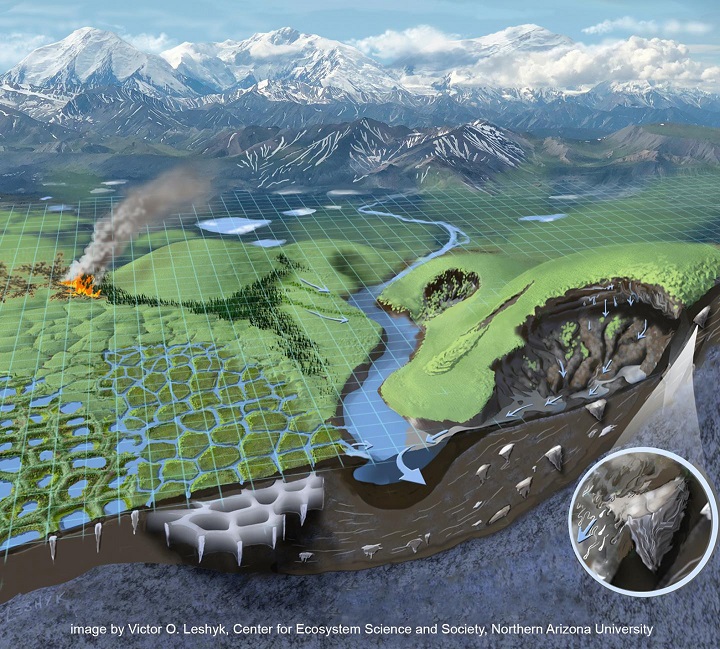
特刊详情
客座编辑
- Jing Tao,美国劳伦斯伯克利国家实验室
- Anna Liljedahl,美国伍德威尔气候研究中心
- Christopher Burn,加拿大卡尔顿大学
- Guido Grosse, 德国阿尔弗雷德·韦格纳研究所亥姆霍兹极地和海洋研究中心
- Jeannette Noetzli, 瑞士WSL雪崩研究所
- Scott Goetz,美国北亚利桑那大学
- Thomas Douglas, 美国陆军寒冷地区研究和工程实验室
- 杨元合,中国科学院植物研究所
主题范围
Suggested, but not exhaustive, topics of interest for this collection include:
- Observation synthesis from long-term permafrost monitoring networks.
- Geophysical and remote sensing investigations of changing permafrost landscapes.
- Response of permafrost rivers, deltas, and coastlines to climate warming.
- The role of ground ice and water in permafrost carbon dynamics.
- Snow, vegetation, and permafrost interactions.
- Microorganisms and their processes in permafrost.
- Changing biogeochemistry of permafrost regions.
- Permafrost environmental contamination under climate warming.
- Mountain permafrost in a warming world.
- Data-model fusion advancements in monitoring and predicting permafrost vulnerability.
- Infrastructure and transportation engineering on permafrost.
This focus collection has been organised in partnership with the 2021 Regional Conference on Permafrost (RCOP) and 19th International Conference on Cold Regions Engineering (ICCRE).
特刊文章
Editorial
Jing Tao et al 2025 Environ. Res. Lett. 20 100201
Letters
Yifeng Wang et al 2024 Environ. Res. Lett. 19 014009
Permafrost degradation and soil erosion as drivers of greenhouse gas emissions from tundra ponds
Vilmantas Prėskienis et al 2024 Environ. Res. Lett. 19 014072
Caiyun Zhang et al 2023 Environ. Res. Lett. 18 015003
Quantification of active layer depth at multiple scales in Interior Alaska permafrost
David Brodylo et al 2024 Environ. Res. Lett. 19 034013
Andreas Kellerer-Pirklbauer et al 2024 Environ. Res. Lett. 19 034022
Chen Wang et al 2024 Environ. Res. Lett. 19 034030
Léa Courtial-Manent et al 2024 Environ. Res. Lett. 19 034037
The thermal response of permafrost to coastal floodplain flooding
Yu Zhang et al 2023 Environ. Res. Lett. 18 035004
Potential nitrogen mobilisation from the Yedoma permafrost domain
Jens Strauss et al 2024 Environ. Res. Lett. 19 043002
The thermal effect of snow cover on ground surface temperature in the Northern Hemisphere
Xiaoqing Peng et al 2024 Environ. Res. Lett. 19 044015
Sylvain Fiolleau et al 2024 Environ. Res. Lett. 19 044021
Synthetic aperture radar (SAR) detects large gas seeps in Alaska lakes
Melanie Engram and Katey Walter Anthony 2024 Environ. Res. Lett. 19 044034
Joel F Eklof et al 2024 Environ. Res. Lett. 19 044055
Zhen Li et al 2024 Environ. Res. Lett. 19 044069
Post-drainage vegetation, microtopography and organic matter in Arctic drained lake basins
Juliane Wolter et al 2024 Environ. Res. Lett. 19 045001
Winter soil temperature varies with canopy cover in Siberian larch forests
Michael M Loranty et al 2024 Environ. Res. Lett. 19 054013
Jing Tao et al 2024 Environ. Res. Lett. 19 054027
Christopher C M Baker et al 2023 Environ. Res. Lett. 18 055001
Preconditioning of mountain permafrost towards degradation detected by electrical resistivity
Christian Hauck and Christin Hilbich 2024 Environ. Res. Lett. 19 064010
Missing nitrogen source during ecosystem succession within retrogressive thaw slumps in Alaska
Kate M Buckeridge et al 2023 Environ. Res. Lett. 18 0
Valeria Briones et al 2024 Environ. Res. Lett. 19 074003
S Morard et al 2024 Environ. Res. Lett. 19 074074
Elevation dependency of future degradation of permafrost over the Qinghai-Tibet Plateau
Guofei Zhang et al 2023 Environ. Res. Lett. 18 075005
M Isabel Smith et al 2024 Environ. Res. Lett. 19 084041
Prashant Baral et al 2023 Environ. Res. Lett. 18 093005
Jingjing Yang et al 2023 Environ. Res. Lett. 18 094038
Advances in operational permafrost monitoring on Svalbard and in Norway
Ketil Isaksen et al 2022 Environ. Res. Lett. 17 095012
Attributing observed permafrost warming in the northern hemisphere to anthropogenic climate change
Lukas Gudmundsson et al 2022 Environ. Res. Lett. 17 095014
Ziyi Wang et al 2023 Environ. Res. Lett. 18 104003
Effect of permafrost degradation on grassland net primary productivity in Qinghai–Tibet Plateau
Jianan Hu et al 2024 Environ. Res. Lett. 19 104051
Carbon dioxide release from retrogressive thaw slumps in Siberia
C Beer et al 2023 Environ. Res. Lett. 18 104053
Zekun Ding et al 2023 Environ. Res. Lett. 18 114010
Variability in terrestrial characteristics and erosion rates on the Alaskan Beaufort Sea coast
Anastasia Piliouras et al 2023 Environ. Res. Lett. 18 114050
Evidence for unexpected net permafrost aggradation driven by local hydrology and climatic triggers
Anastasia E Sniderhan et al 2023 Environ. Res. Lett. 18 115001
Investigating permafrost carbon dynamics in Alaska with artificial intelligence
B A Gay et al 2023 Environ. Res. Lett. 18 125001
期刊介绍

- 2024年影响因子:5.6 Citescore: 11.1
- Environmental Research Letters(ERL)以金色开放获取模式出版,作者可选择将原始数据作为补充资料与文章一起发表。所有研究人员可以免费获取这些研究成果。ERL汇聚了关注环境变化及其应对的研究团体和政策制定团体的意见,涵盖了环境科学的所有方面,出版研究快报、综述文章、观点和社论。ERL顺应了环境科学的跨学科发表的趋势,反映了该领域相关的方法、工具和评估战略,得到了来自不同领域的广泛贡献。