



JPCM研究路线图|The 2025 motile active matter roadmap
17 Jul 2026 gabriels
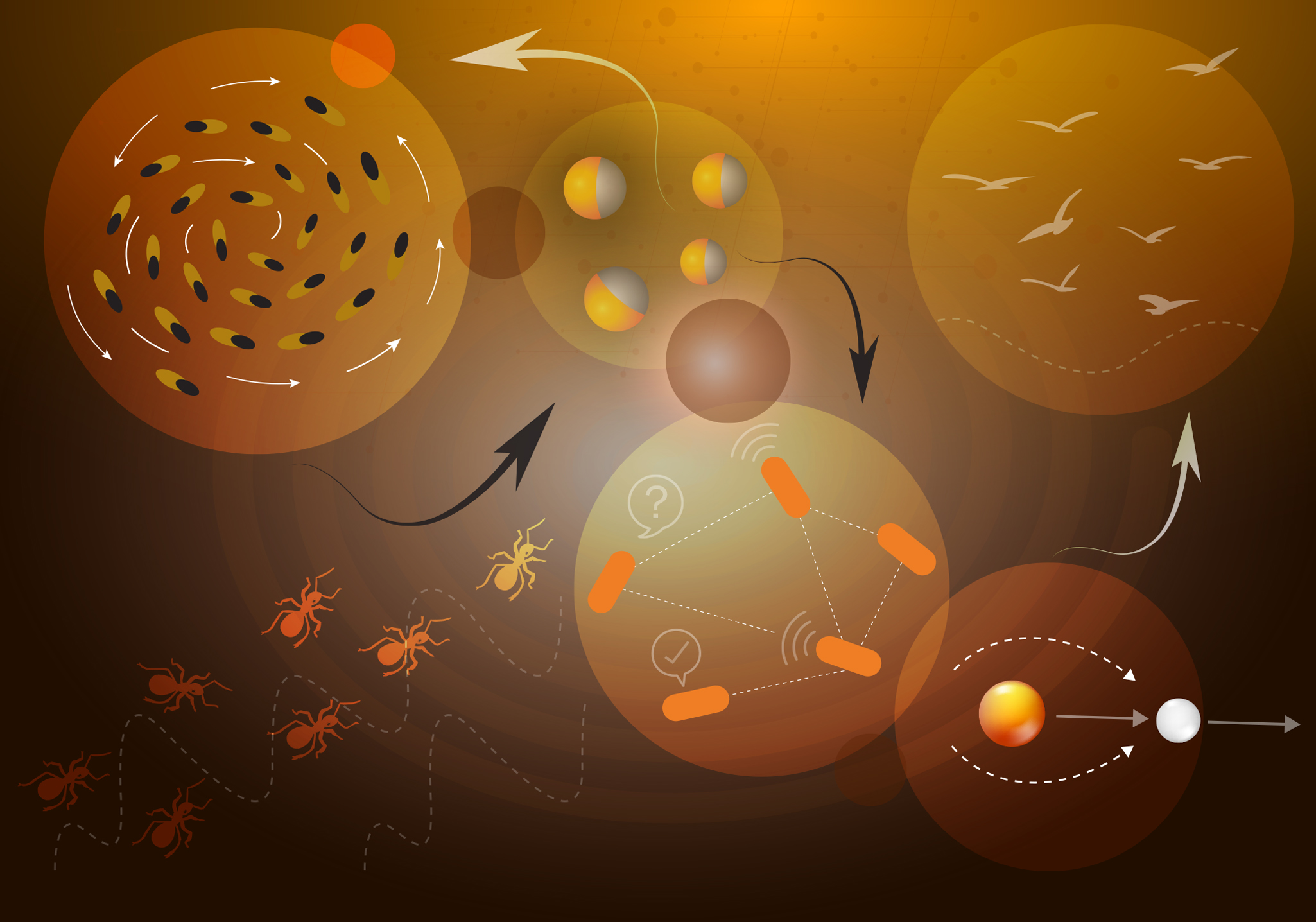
Activity and autonomous motion are fundamental aspects of many living and engineering systems. Here, the scale of biological agents covers a wide range, from nanomotors, cytoskeleton, and cells, to insects, fish, birds, and people. Inspired by biological active systems, various types of autonomous synthetic nano- and micromachines have been designed, which provide the basis for multifunctional, highly responsive, intelligent active materials. A major challenge for understanding and designing active matter is their inherent non-equilibrium nature due to persistent energy consumption, which invalidates equilibrium concepts such as free energy, detailed balance, and time-reversal symmetry. Furthermore, interactions in ensembles of active agents are often non-additive and non-reciprocal. An important aspect of biological agents is their ability to sense the environment, process this information, and adjust their motion accordingly. It is an important goal for the engineering of micro-robotic systems to achieve similar functionality. Many fundamental properties of motile active matter are by now reasonably well understood and under control. Thus, the ground is now prepared for the study of physical aspects and mechanisms of motion in complex environments, the behavior of systems with new physical features like chirality, the development of novel micromachines and microbots, the emergent collective behavior and swarming of intelligent self-propelled particles, and particular features of microbial systems. The vast complexity of phenomena and mechanisms involved in the self-organization and dynamics of motile active matter poses major challenges, which can only be addressed by a truly interdisciplinary effort involving scientists from biology, chemistry, ecology, engineering, mathematics, and physics. The 2025 motile active matter roadmap of Journal of Physics: Condensed Matter reviews the current state of the art of the field and provides guidance for further progress in this fascinating research area.


文章介绍

The 2025 motile active matter roadmap

Gerhard Gompper, Howard A Stone, Christina Kurzthaler, David Saintillan, Fernado Peruani, Dmitry A Fedosov, Thorsten Auth, Cecile Cottin-Bizonne, Christophe Ybert, Eric Clément, Thierry Darnige, Anke Lindner, Raymond E Goldstein, Benno Liebchen, Jack Binysh, Anton Souslov, Lucio Isa, Roberto di Leonardo, Giacomo Frangipane, Hongri Gu, Bradley J Nelson, Fridtjof Brauns, M Cristina Marchetti, Frank Cichos, Veit-Lorenz Heuthe, Clemens Bechinger, Amos Korman, Ofer Feinerman, Andrea Cavagna, Irene Giardina, Hannah Jeckel and Knut Drescher

通讯作者:

  • Gerhard Gompper,德国于利希研究中心

期刊介绍

Journal of Physics: Condensed Matter

  • 2025年影响因子:2.9  Citescore: 4.8
  • Journal of Physics: Condensed Matter (JPCM)为读者提供凝聚态物理、软物质、纳米科学和生物物理各领域的最新研究成果。JPCM发表实验/理论分析和模拟研究,读者可以获取涉及下列领域的专题综述、快报和特刊:表面、界面和原子尺度的科学,液体、软物质和生物物理,纳米材料和纳米电子,固体结构的晶格动力,电子结构,超导体和金属、半导体,电介质和铁电,以及磁学与磁性材料。