特刊详情
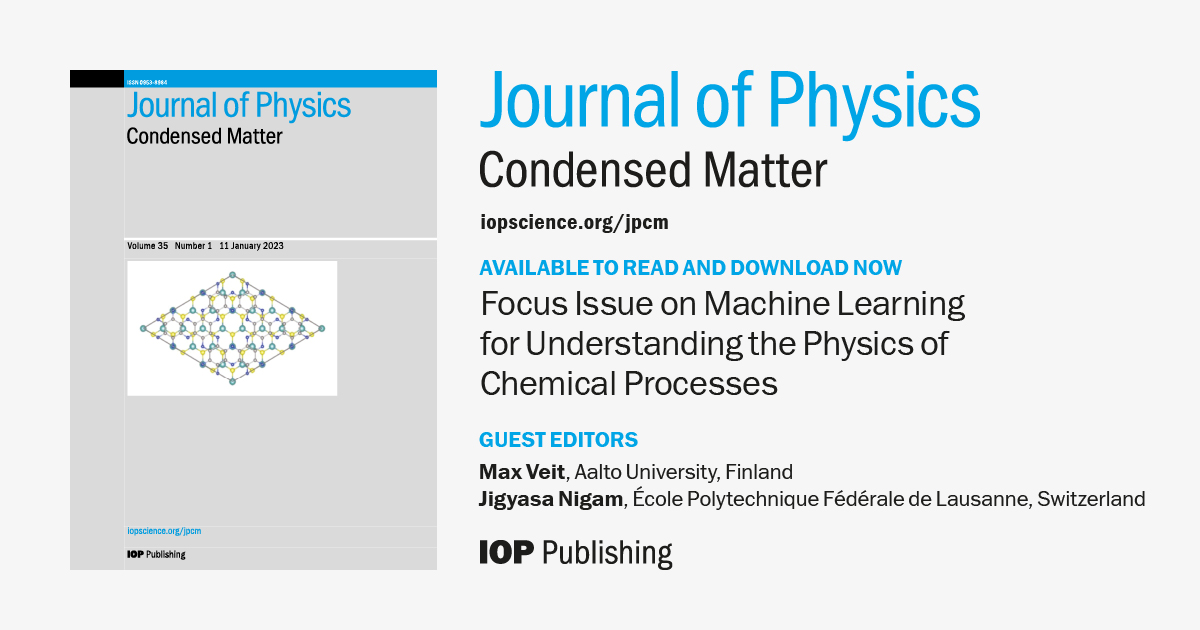
客座编辑
- Max Veit,芬兰阿尔托大学
- Jigyasa Nigam,瑞士洛桑联邦理工学院
主题范围
Machine learning (ML) techniques have revolutionized the study of complex physical and chemical phenomena by enabling the simulation of large systems over long timescales with near quantum-mechanical accuracy. They are now routinely applied to a wide variety of systems from molecular to solid state, offering insights into processes ranging from fundamental thermodynamic observables, prediction of reaction pathways and catalytic processes, characterization of intermolecular interactions, and coupling of systems with their environments. Not only do such techniques facilitate a comprehensive understanding of the fundamental principles governing chemical processes but they can also actively drive applications of broad fundamental interest and societal benefit, such as clean energy generation and storage systems, next-generation computing technologies, novel structural and functional materials, and drug design and discovery.
This focus issue aims to showcase the role of ML in deepening and expanding our physical understanding of chemical processes in systems of current scientific and technological interest. It will emphasize the continuing evolution of ML techniques, especially their synergistic integration with quantum mechanical (QM) and electronic structure techniques, or their role in strengthening the productive collaboration between theory and experiment.
We welcome contributions on any topics within this broad and diverse field, but are particularly interested in those that either present innovative ML techniques to:
-
Predict experimental observables from the QM basis
-
Improve existing models to better reflect observed physics
-
Characterize reaction pathways and networks
-
Provide new methods for structure prediction and discovery
or that present new and challenging scientific applications, for example in the following areas:
-
Batteries and energy materials
-
-
-
Amorphous and disordered solids
-
Protein structure and biomolecular chemistry
-
-
Molecular and ionic liquids
投稿流程
特刊文章与JPCM期刊常规文章遵循相同的审稿流程和内容标准,并采用同样的投稿模式。
有关准备文章及投稿的详细信息,可以参阅IOPscience页面的作者指南。
作者可登入期刊主页进行在线投稿,先选择“文章类型”,然后在“选择特刊”的下拉框中选择“Focus Issue on Machine Learning for Understanding the Physics of Chemical Processes”。