

JPhys Complexity特刊征稿|Focus on Complex Quantum Networks
21 Nov 2026 gabriels

特刊详情

客座编辑

  • István Kovács,美国西北大学
  • Johannes Nokkala,芬兰图尔库大学
  • Valentina Parigi,法国卡斯特勒-布罗塞尔实验室


主题范围

Network theory has been immensely successful in taming the complexity of systems as diverse as the World Wide Web, citation networks and electrical grids: link analysis and centrality measures can power search engines, community detection algorithms can identify similar research topics, and study of how local failures can spread can help prevent catastrophic power outages. In particular, it has been increasingly used together with quantum theory, which is one of our most successful descriptions of Nature to date.
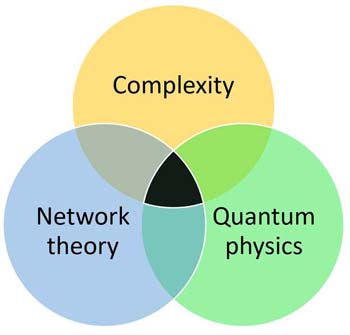
This field of complex quantum networks lives in the intersection of complex systems, network, and quantum theory. For example, one may use network measures calculated from a network representation of a ground state to predict a quantum phase transition, study how quantum statistics emerge from an evolving network, or link the efficiency of quantum communication network to its topological features. Research in the field features prominently network universality classes such as small-world, scale-free and random networks.This focus issue is concerned with all aspects of this relatively young field. Especially the exploration of beneficial cross-pollination between its different research avenues, such as applying states with a network structure in quantum communication networks, and the use of more advanced networks such as multiplex, higher order, temporal, chiral, and fractal networks, present opportunities to unify and advance the field.

Topics included in this focus issue include, but are not limited to:

  • Quantum communication networks: statistical properties, entanglement distribution, quantum key distribution
  • Quantum simulation of complex networks
  • Networks of interacting quantum systems: probing, interplay between topology and phase transitions, synchronization
  • Network description of quantum states or experimental setups, graphical calculus of quantum dynamics
  • Non-locality in networks, such as violation of Bell inequalities or steering
  • Quantum walks on networks: efficiency, spatial search, inference of network structure


投稿流程

特刊文章与JPhys Complexity期刊常规文章遵循相同的审稿流程和内容标准,并采用同样的投稿模式。

有关准备文章及投稿的详细信息,可以参阅IOPscience页面的作者指南。

作者可登入期刊主页进行在线投稿,先选择文章类型,然后在“选择特刊”的下拉框中选择“Focus on Complex Quantum Networks”。

投稿截止日期:2026年12月31日。


期刊介绍

JPhys Complexity

  • 2025年影响因子:2.3  Citescore:3.6
  • JPhys Complexity是一本开放获取期刊,发表了与复杂系统和网络相关的众多领域的重要成果和前沿进展,由于这是一个跨学科的期刊,它不仅涉及物理学还涵盖了生物学、化学、环境科学、社会科学、经济学等众多学科领域。