


NANOF研究路线图|原子级工程量子平台路线图

08 Jan 2026 gabriels
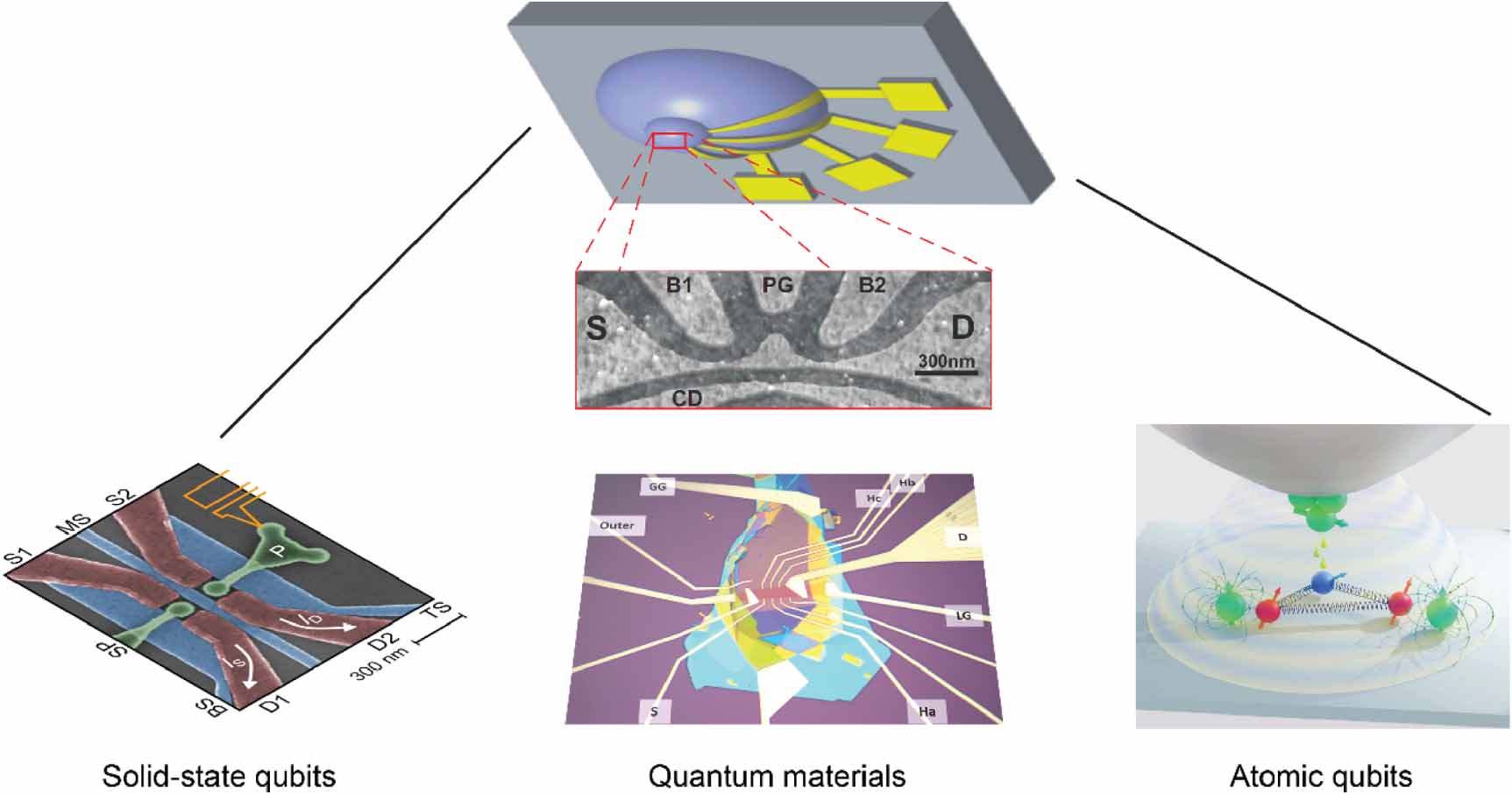
Matter at the atomic-scale is inherently governed by the laws of quantum mechanics. This makes charges and spins confined to individual atoms—and interactions among them—an invaluable resource for fundamental research and quantum technologies alike. However, harnessing the inherent ‘quantumness’ of atomic-scale objects requires that they can be precisely engineered and addressed at the individual atomic level. Since its invention in the 1980s, scanning tunnelling microscopy (STM) has repeatedly demonstrated the unrivalled ability to not only resolve but manipulate matter at atomic length scales. Over the past decades, this has enabled the design and investigation of bottom-up tailored nanostructures as reliable and reproducible platforms to study designer quantum physics and chemistry, band topology, and collective phenomena. The vast range of STM-based techniques and modes of operation, as well as their combination with electromagnetic fields from the infrared to microwave spectral range, has even allowed for the precise control of individual charge and spin degrees of freedom. This roadmap reviews the most recent developments in the field of atomically-engineered quantum platforms and explores their potential in future fundamental research and quantum technologies.


文章介绍

Roadmap on atomically-engineered quantum platforms

Soo-hyon Phark, Bent Weber, Yasuo Yoshida, Patrick R Forrester, Robertus J G Elbertse, Joseph A Stroscio, Hao Wang, Kai Yang, Leo Gross, Shantanu Mishra, Fabian Paschke, Katharina Kaiser, Shadi Fatayer, Jascha Repp, Harry L Anderson, Diego Peña, Florian Albrecht, Franz J Giessibl, Roman Fasel, Joaquín Fernández-Rossier, Shigeki Kawai, Laurent Limot, Nicolás Lorente, Berthold Jäck, Haonan Huang, Joachim Ankerhold, Christian R Ast, Martina Trahms, Clemens B Winkelmann, Katharina J Franke, Martina O Soldini, Glenn Wagner, Titus Neupert, Felix Küster, Souvik Das, Stuart S P Parkin, Paolo Sessi, Zhenyu Wang, Vidya Madhavan, Rupert Huber, Gagandeep Singh, Fabio Donati, Stefano Rusponi, Harald Brune, Eufemio Moreno-Pineda, Mario Ruben, Wolfgang Wernsdorfer, Wantong Huang, Kwan Ho Au-Yeung, Philip Willke, Andreas J Heinrich, Susanne Baumann, Sebastian Loth, Lukas M Veldman, Sander Otte, Christoph Wolf, Lisanne Sellies, Steven R Schofield, Michael E Flatté, Joris G Keizer and Michelle Y Simmons


通讯作者:

  • Soo-hyon Phark,韩国基础科学研究所量子纳米科学中心、韩国梨花女子大学
  • Bent Weber,新加坡南洋理工大学
  • Yasuo Yoshida,日本金泽大学

期刊介绍

Nano Futures

  • 2024年影响因子:3.3  Citescore:5.2
  • Nano Futures(NANOF)是一本具有高影响力的多学科、交叉学科期刊,捕捉开拓性研究和对纳米科学产生长远影响的未来导向性研究。这本期刊将为纳米领域的科研人员提供一个独特的新平台。在快速发表具有重大发现的研究工作的同时,首要任务是将具有高影响力的内容与高质量的作者服务相结合。