


NANOF研究路线图|原子级半导体器件路线图

20 Jan 2026 gabriels
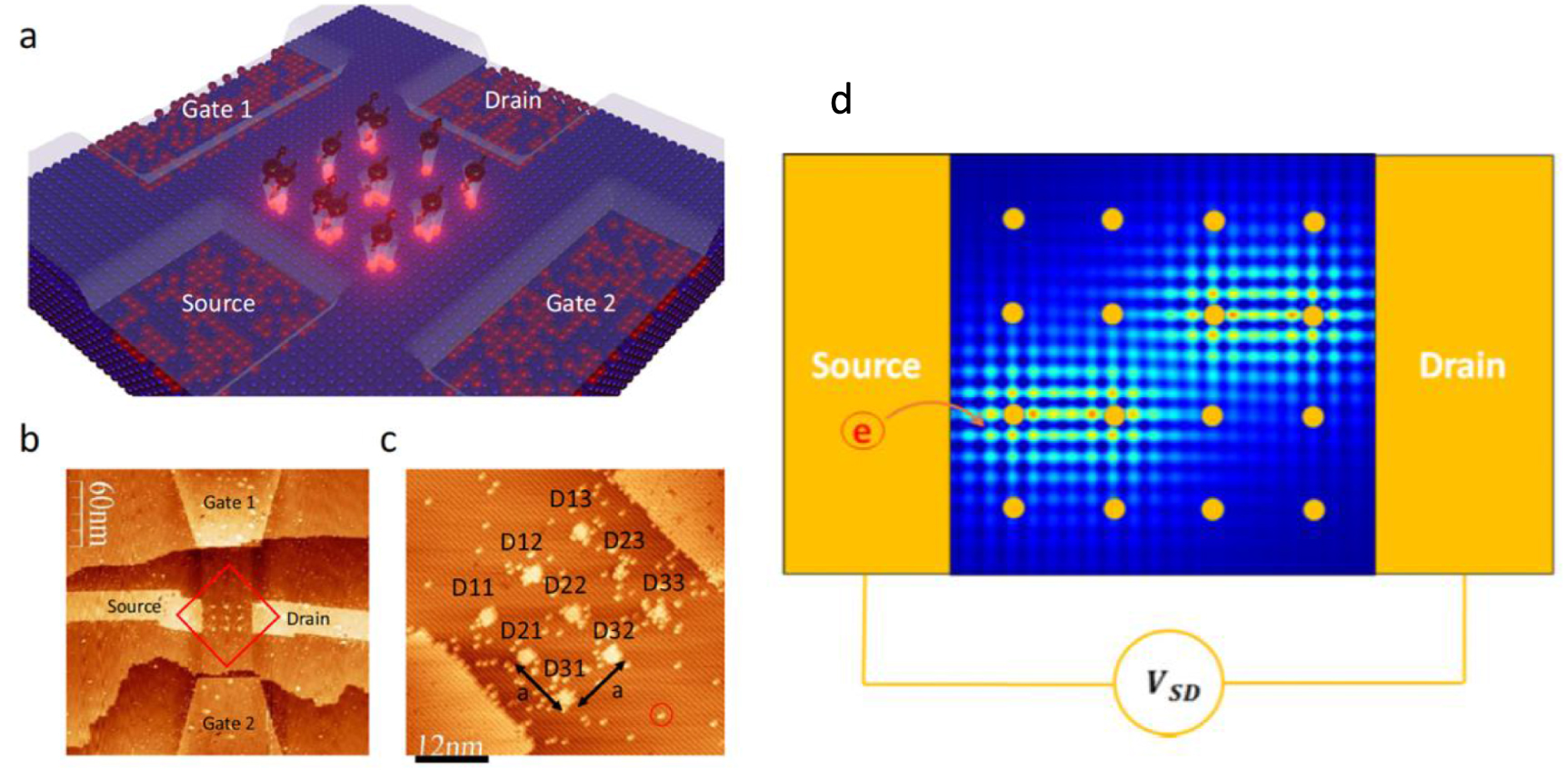
Spin states in semiconductors provide exceptionally stable and noise-resistant environments for qubits, positioning them as optimal candidates for reliable quantum computing technologies. The proposal to use nuclear and electronic spins of donor atoms in silicon, introduced by Kane in 1998, sparked a new research field focused on the precise positioning of individual impurity atoms for quantum devices, utilising scanning tunnelling microscopy and ion implantation. This roadmap article reviews the advancements in the 25 years since Kane’s proposal, the current challenges, and the future directions in atomic-scale semiconductor device fabrication and measurement. It covers the quest to create a silicon-based quantum computer and expands to include diverse material systems and fabrication techniques, highlighting the potential for a broad range of semiconductor quantum technological applications. Key developments include phosphorus in silicon devices such as single-atom transistors, arrayed few-donor devices, one- and two-qubit gates, three-dimensional architectures, and the development of a toolbox for future quantum integrated circuits. The roadmap also explores new impurity species like arsenic and antimony for enhanced scalability and higher-dimensional spin systems, new chemistry for dopant precursors and lithographic resists, and the potential for germanium-based devices. Emerging methods, such as photon-based lithography and electron beam manipulation, are discussed for their disruptive potential. This roadmap charts the path toward scalable quantum computing and advanced semiconductor quantum technologies, emphasising the critical intersections of experiment, technological development, and theory.


文章介绍

Roadmap on atomic-scale semiconductor devices

Steven R Schofield, Andrew J Fisher, Eran Ginossar, Joseph W Lyding, Richard Silver, Fan Fei, Pradeep Namboodiri, Jonathan Wyrick, Mateus G Masteghin, David C Cox, Benedict N Murdin, Steven K Clowes, Joris G Keizer, Michelle Y Simmons, Holly G Stemp, Andrea Morello, Benoit Voisin, Sven Rogge, Robert A Wolkow, Lucian Livadaru, Jason Pitters, Taylor J Z Stock, Neil J Curson, Robert E Butera, Tatiana V Pavlova, A M Jakob, D Spemann, P Räcke, F Schmidt-Kaler, D N Jamieson, Utkarsh Pratiush, Gerd Duscher, Sergei V Kalinin, Dimitrios Kazazis, Procopios Constantinou, Gabriel Aeppli, Yasin Ekinci, James H G Owen, Emma Fowler, S O Reza Moheimani, John Randall, Shashank Misra, Jeffrey A Ivie, Christopher R Allemang, Evan M Anderson, Ezra Bussmann, Quinn Campbell, Xujiao Gao, Tzu-Ming Lu and Scott W Schmucker


通讯作者:

  • Steven R Schofield,英国伦敦大学学院

期刊介绍

Nano Futures

  • 2024年影响因子:3.3  Citescore:5.2
  • Nano Futures(NANOF)是一本具有高影响力的多学科、交叉学科期刊,捕捉开拓性研究和对纳米科学产生长远影响的未来导向性研究。这本期刊将为纳米领域的科研人员提供一个独特的新平台。在快速发表具有重大发现的研究工作的同时,首要任务是将具有高影响力的内容与高质量的作者服务相结合。