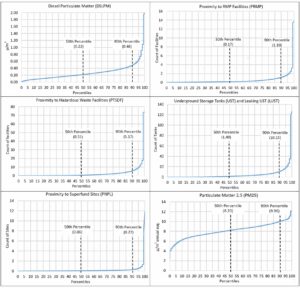
Mohai and Lee analyse the concentration of 13 environmental burdens across the United States and their relationship with vulnerable populations, using data from the EPA’s EJScreen database. The study shows that both the intensity and number of environmental burdens are positively associated with higher concentrations of vulnerable groups, particularly people of color and individuals with limited English proficiency. The findings highlight how historical public policies have contributed to persistent demographic disparities in environmental exposure.
Assessing corporate social responsibility pressures in lithium mining: a topic modeling analysis approach
Datu Buyung Agusdinata, Nicole Darnall and Hallie Eakin
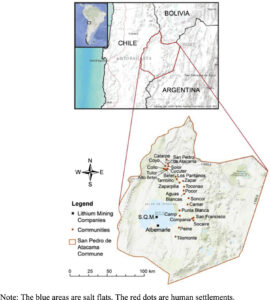
This study applies topic modeling to stakeholder communication data from Chile’s lithium mining sector between 2010 and 2022 to assess corporate social responsibility (CSR) pressures. Agusdinata et al. find that leading mining companies primarily enact CSR through annual sustainability reports, with CSR efforts closely linked to external pressures such as regulatory fines, activism, and investor demands. The results shed light on how social and institutional forces shape CSR practices in critical mineral supply chains.
Energy services – the missing link in a just and zero-carbon urban transition
Kangkang Tong and Lynette Cheah
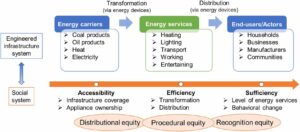
In this Perspective, Tong and Cheah argue that energy services—rather than energy supply alone—form the crucial link between energy use, social equity, and human well-being. The authors note that current zero-carbon urban transition models often overlook this dimension, limiting their ability to address justice concerns. They propose conceptual and methodological advances to better integrate energy services into urban energy models, supporting more just and people-centred decarbonisation pathways.
Economic assessment of SRM under socio-political and geophysical tipping dynamics
Francisco Estrada, Bernardo A Bastien-Olvera, Oscar Calderon-Bustamante, Miguel A Altamirano, Rodrigo Muñoz-Sánchez, Juan Moreno-Cruz and Wouter Botzen
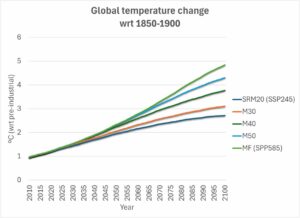
Estrada et al. evaluate the economic viability of solar radiation modification (SRM) as a climate policy option, emphasising the risks associated with governance failure and abrupt termination. Introducing a socio-political–geophysical tipping point framework, the study finds that SRM is only economically beneficial under a very narrow set of conditions, including strong global mitigation, extremely low failure risk, and a gradual phase-out. The analysis highlights a fundamental tension between governance challenges and the safe deployment of SRM.
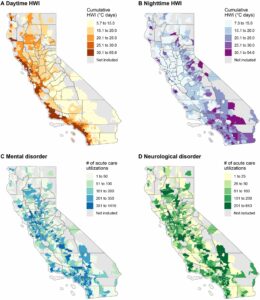
Daytime and nighttime heatwave intensity and acute care utilization for mental and neurological disorders in California
Yiqun Ma, Kristen Guirguis, Caitlin G Jones-Ngo, Anais Teyton, Haley E Brown, Fiona Charlson, Michael Jerrett, Rachel Connolly, Alexander Gershunov, Miriam E Marlier and Tarik Benmarhnia
Ma et al. examine the relationship between heatwave intensity and acute care utilisation for mental and neurological disorders in California from 2006 to 2019. The study finds that nighttime heatwaves are more strongly associated with most disorder subtypes, while daytime heatwaves have a greater impact on conduct disorders. As nighttime heatwaves become more frequent, the authors call for innovative heat preparedness strategies and increased awareness among public health practitioners.